Palomar Knot Step by Step

You feel the tap-tap, set the hook hard, and for a glorious moment, you’re connected to a powerful fish. Then, nothing. Your line goes slack, and you reel in a sad, curly cue of monofilament with a perfect, tiny loop at the end. Sound familiar? That “pigtail” is the telltale sign of a knot failure, and it’s robbed more anglers of fish than any lure choice or bad cast ever could.
Today, we’re putting an end to that. We’re going to master the Palomar knot. In my two decades guiding, I’ve seen this simple knot win tournaments and save heartbreak for beginners. It’s the most reliable connection in fishing, and once you learn it, it becomes as automatic as tying your shoes.
Disclaimer: Fish Legally & Ethically
Before we tie anything, let’s get the essentials straight. This information is for educational purposes. You are responsible for knowing and following all local regulations. In the USA, you must possess a valid fishing license for the state you are in. Regulations on seasons, bag limits, and species are not suggestions—they are the law, designed to conserve our fisheries for generations. Always check with your state’s wildlife agency for the most current rules. Practice ethical catch and release by handling fish with wet hands, minimizing air exposure, and using appropriate tackle to land them quickly.
The Science of a Simple Loop: Why the Palomar is King
Think of your fishing line as a chain. A bad knot is the weak link that will always break first under pressure. Most knots fail because they create sharp bends and friction points that cut into themselves. The Palomar fishing knot is brilliant in its simplicity because it uses a double line through the eye of the hook, creating a noose-like loop that cinches down evenly.
The analogy I use is a mountaineer’s carabiner. You wouldn’t clip a single, thin strand of rope to the carabiner and trust your life to it. You’d loop it through, doubling the contact points and distributing the force. The Palomar does exactly that for your hook or lure. It maintains nearly 100% of your line’s original strength, which is why it’s the go-to knot for braided line, where other knots often slip.
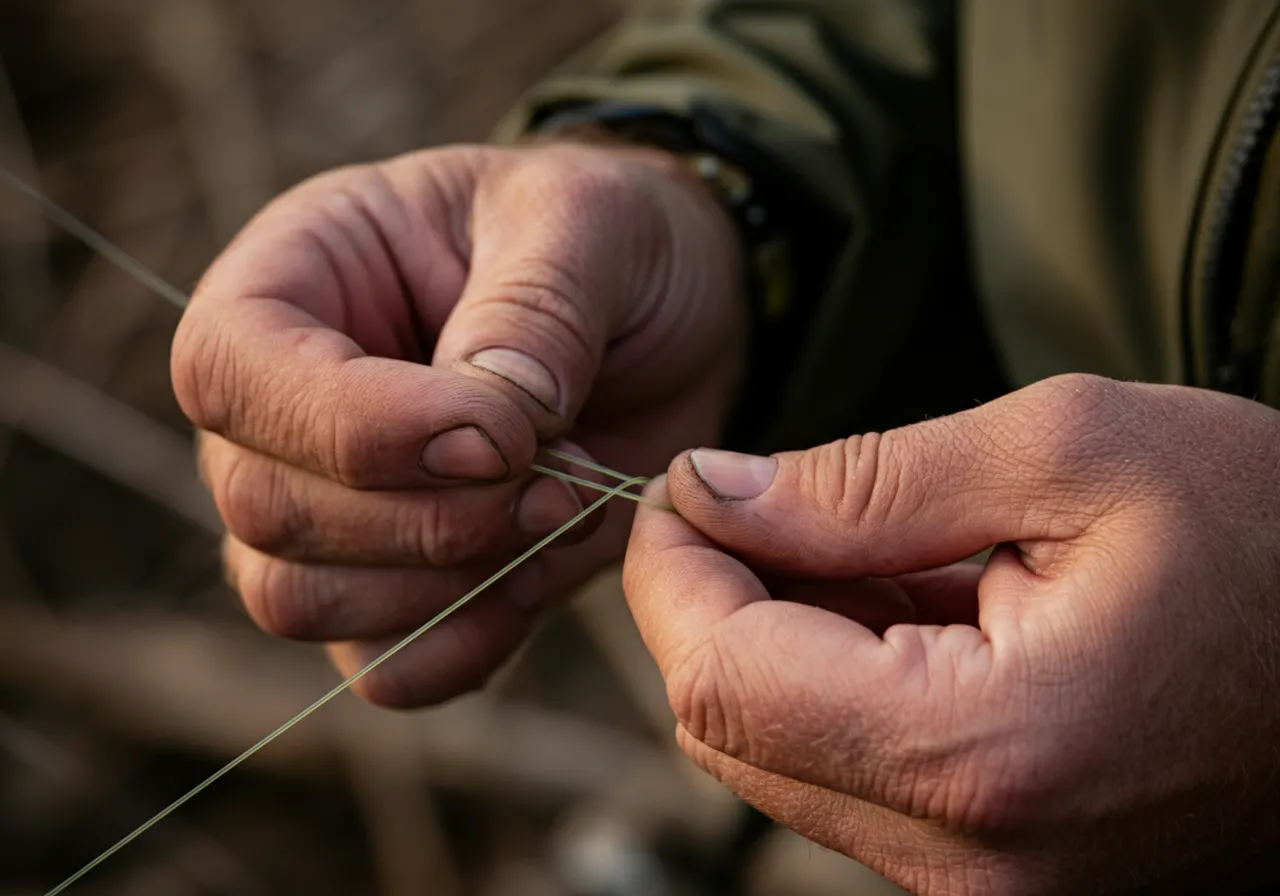
Palomar Knot Tying Instructions: A Foolproof, 5-Step Method
You can tie this in the dark, in the rain, or with cold fingers. Follow these steps:
- Double Up: Take about 18-24 inches of line and pass it through the eye of the hook or lure, pulling through a generous amount. Then, fold it back to create a double line, making a loop that’s 6-8 inches long.
- The Simple Overhand: Take the end of the loop (where the two strands are together) and tie a simple, loose overhand knot. Do not tighten it. You should now have your hook/lure dangling below a loose overhand knot with a loop hanging out.
- Pass the Loop: Here’s the magic move. Take the loose loop you just created and pass it over the entire hook or lure. For a lure with a treble hook, you may need to open the loop wide to slip it over.
- Moisten and Cinch: Before pulling anything tight, wet the knot with saliva or water. This reduces friction heat and allows the knot to seat properly. Now, slowly pull on both the standing line (main line from your reel) and the tag end simultaneously. Watch the knot slide down and cinch neatly above the hook eye.
- Trim and Fish: Pull firmly on the standing line to ensure it’s tight. Trim the tag end, leaving about 1/8 to 1/4 inch. Don’t cut it flush against the knot.
When to Use the Palomar Knot (And When Not To)
- Best For: Tying directly to hooks, swivels, and lures (especially with braided line). It’s perfect for terminal tackle where a strong, compact knot is needed.
- Not Ideal For: Connecting line to line (use a Double Uni or FG Knot). Also, it can be wasteful with large, bulky lures or when using very expensive fluorocarbon, as it requires doubling the line.
Knot Showdown: Palomar vs. The Common Challenger
How does the Palomar stack up against the other “easy” knot everyone learns first? Let’s break it down.
| Feature | Palomar Knot | Improved Clinch Knot |
|---|---|---|
| Ease of Tying | Very Easy (5 simple steps) | Easy (but more wraps to remember) |
| Strength | Extremely High (~95-100% line strength) | High (~85-90% line strength) |
| Best Line Type | Excellent with Braid, Great with Mono/Fluoro | Good with Mono/Fluoro, Poor with Braid (can slip) |
| Bulk | Low profile | Can be bulkier |
| Weakness | Uses more line; tricky with large lure eyes | Can weaken line with too many wraps; prone to slippage with braid |
| Verdict | The all-around champion for terminal connections. | A classic, but has been largely surpassed for most applications. |
The Real-World Pros & Cons
Pros:
- Unbeatable Strength: It’s the strongest knot for its purpose, period.
- Braid-Friendly: Its design grips braided line perfectly, eliminating slip.
- Simple & Fast: Once muscle memory kicks in, you’ll tie it in seconds.
- Works in the Dark: The steps are tactile, not visual.
Cons:
- Line Waste: You need a longer tag end to start, which can feel wasteful with pricey fluorocarbon.
- Bulky Lure Limitation: Passing the loop over a large crankbait or swim bait can be awkward.
- Not a Line-to-Line Knot: It’s strictly for connecting to a terminal tackle eye.
Palomar Knot FAQ
Can I use the Palomar knot with fluorocarbon?
Absolutely. It’s an excellent knot for fluorocarbon. Just remember to moisten it thoroughly before cinching, as fluoro is more susceptible to heat damage from friction.
How many times should I pass the line through the hook eye?
Just once. The strength comes from the double line and the loop structure, not from multiple passes through the eye. One clean pass is all you need.
My Palomar knot keeps slipping with braid. What am I doing wrong?
If a Palomar is slipping with braid, you are likely not cinching it down completely or you trimmed the tag end before giving the standing line a final, hard pull. Ensure the knot is fully seated and tight against the hook eye before trimming.
Mastering this one fishing knot will boost your confidence on the water more than any new rod or reel. It turns a point of failure into a point of absolute strength. Now, grab some spare line and practice it ten times. Make it yours. Then, get out there, tie it on with confidence, and start landing the fish that used to get away.
Ready to put your new knot to the test? Browse our other guides on reading water, selecting the right lure, and advanced techniques to become a more complete angler.
Bottom Line
The Palomar knot is a simple, five-step knot that provides near-perfect line strength, works flawlessly with braided line, and is one of the most reliable connections an angler can learn. Ditch the weak knots and make this your standard for tying on hooks and lures.