Streamer Fishing for Big Browns

You’ve spent countless hours drifting nymphs through perfect seams and delicately presenting dry flies to rising fish. You’ve caught trout. But the truly monster brown trout, the ones that haunt your dreams, seem to live in a different world. They ignore your subtle offerings. The secret? Stop asking politely and start knocking on their door. Streamer fishing is the art of triggering the raw, predatory instinct in big trout. It’s not finesse fishing; it’s a declaration of war.
The Predator’s Mind: Why Big Browns Can’t Resist a Streamer
Think of a trophy brown trout’s world like a neighborhood. The smaller fish are the residents, going about their daily business. Your nymphs and dries are like a polite conversation with them. But a big, aggressive streamer? That’s the loud, obnoxious party next door. It’s the commotion of a fleeing baitfish, the silhouette of a wounded sculpin, or the flash of a struggling leech. It represents an easy, high-calorie meal that’s too tempting for an apex predator to ignore. You’re not matching a hatch; you’re creating a crisis that demands a reaction.
Safety, Legality, and Conservation: The Ethical Angler’s Foundation
Before we talk tactics, we must cover the non-negotiables. Pursuing big fish often means wading deep, fishing in low light, or navigating tricky currents.
- Safety First: Always wear a wading belt to prevent your waders from filling with water. Use a wading staff in powerful currents. Check the weather forecast religiously—streamer fishing is fantastic in low-light and stained water, but be aware of rising water levels from upstream storms.
- Legal Compliance: A valid fishing license is mandatory. Regulations on methods, seasons, and harvest limits are in place to protect the fishery. It is your responsibility to know the rules for the specific water you are fishing. Always consult the official regulations from your state’s wildlife agency. For a prime example of comprehensive regulations, you can review the Colorado Parks and Wildlife fishing regulations.
- Ethical Angling & Catch & Release: These fish are the future of the fishery. Use barbless hooks for easier release. Keep the fish in the water as much as possible. Support its belly horizontally—never vertically. Have your tools (forceps, net) ready before you land the fish to minimize handling time. A quick, clean release ensures that trophy brown lives to fight another day.
The Streamer Fishing Arsenal: Gear Built for the Fight
You can’t go to battle with a toothpick. Streamer fishing for large brown trout demands gear that can cast heavy flies, withstand brutal strikes, and control powerful fish.
The Rod, Reel, and Line System
- Rod: A fast-action 6-weight or 7-weight fly rod, 9 feet long, is the ideal workhorse. It has the backbone to punch large flies into the wind and set the hook at long range.
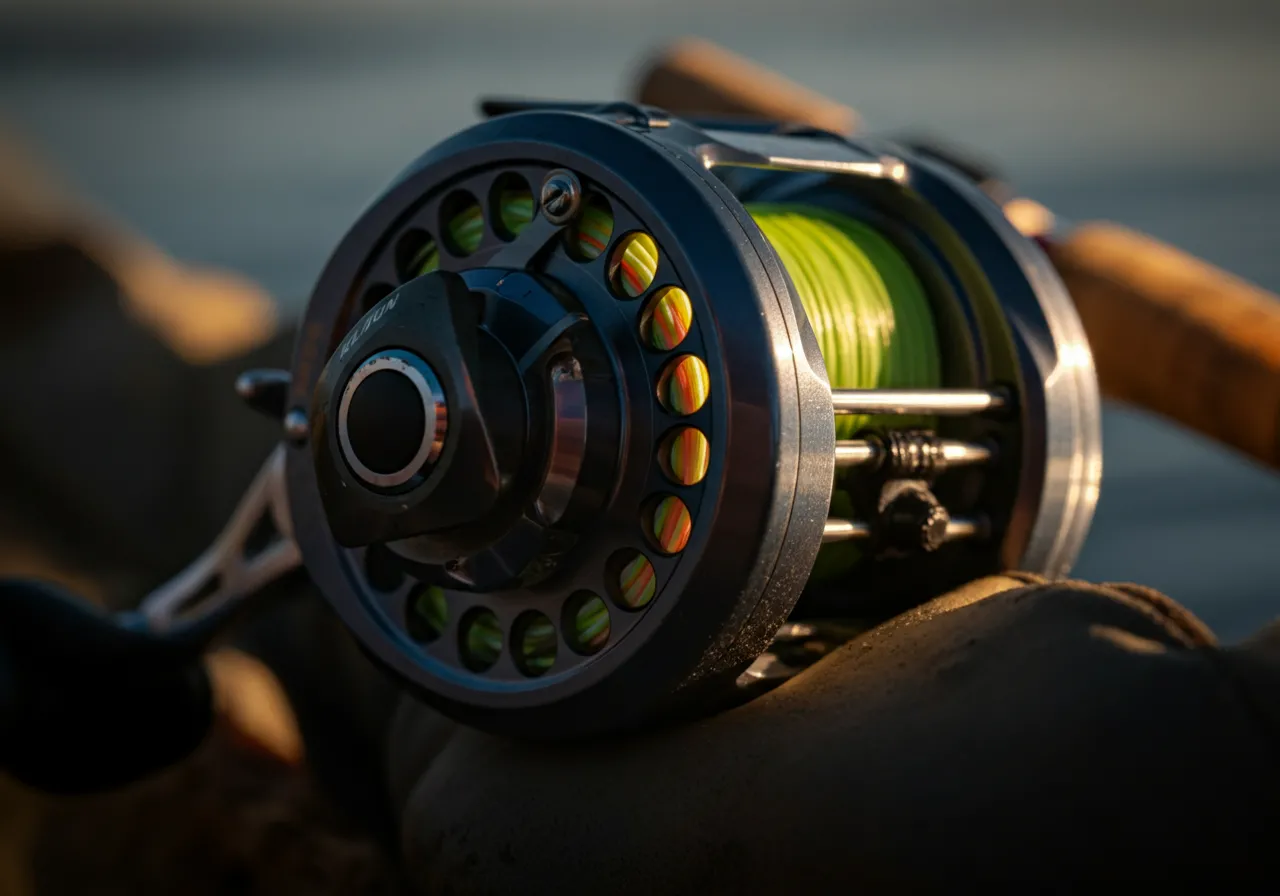
- Reel: A reliable drag is non-negotiable. Big browns make blistering runs. Your reel should have a smooth, sealed drag system and enough capacity for a full fly line plus 100+ yards of 20lb backing.
- Line: This is your engine. A weight-forward floating line is standard, but for deeper presentations, a sink-tip or full intermediate/sinking line is critical. Think of your line as the transmission—it delivers the fly and controls its depth.
Leaders and Tippet
Forget the delicate 6X. You need a short, stout leader. I typically use a 7.5-foot leader tapered to 0X (10lb) or 1X (8lb) fluorocarbon. Fluorocarbon is less visible underwater and has superior abrasion resistance against rocks and teeth.
Mastering the Retrieve: The Art of the “Eat Signal”
Casting the fly is only half the battle. The retrieve is where you speak to the fish. There is no single “right” retrieve, but a core principle: impart life.
- The Strip Set: When you see the flash or feel the thump, do NOT lift the rod tip like in dry fly fishing. Drop the rod tip toward the fish and strip-set hard with your line hand. This drives the hook home against their hard mouth.
- Retrieve Cadences:
- Aggressive Strip: Long, fast strips to imitate a fleeing baitfish. Triggers reaction strikes.
- Strip-Pause: Two short strips, then a pause. The fly darts and then sinks, mimicking an injured or disoriented prey. This is often the deadliest retrieve.
- Slow Roll: A steady, slow retrieve just fast enough to keep the fly moving. Deadly with sculpin or leech patterns near the bottom.
- Reading the Water: Target the predator zones: the heads and tails of deep pools, undercut banks, logjams, and the foam lines where current seams meet. Cast across and slightly downstream, let the fly sink, and begin your retrieve.
Budget Conscious vs. Pro-Grade Streamer Setup
| Gear Component | Budget-Friendly Option (Great to Start) | Pro-Grade Investment (Built for the Long Haul) |
|---|---|---|
| Fly Rod | Quality composite rod from TFO, Redington, or Echo. Excellent performance for the price. | High-modulus graphite rod from Sage, G. Loomis, or Scott. Superior sensitivity, faster recovery, lighter weight. |
| Fly Reel | Lamson Liquid, Redington Behemoth. Reliable drag, good value. | Galvan Torque, Nautilus X-Series. Buttery-smooth, fully sealed drags, exceptional durability. |
| Fly Line | Scientific Anglers Frequency or Air Cel. A good baseline performer. | Scientific Anglers Amplitude Smooth or RIO InTouch. Tighter loops, better coating durability, superior casting feel. |
| Streamer Flies | Standard Bunny Leeches, Woolly Buggers, Clouser Minnows. Effective and inexpensive to lose. | Articulated flies (Dungeon, Kreelex), hand-tuned Game Changers. More complex action, often more durable materials. |
The Honest Pros and Cons of Streamer Fishing
Pros:
- Targets the largest, most aggressive fish in the system.
- Extremely visual and exciting—you often see the strike.
- Effective in a wide range of conditions, including off-color water.
- Can cover vast amounts of water efficiently.
Cons:
- Physically demanding; constant casting and retrieving.
- Catches fewer, but larger, fish compared to nymphing.
- Can be expensive in flies lost to snags.
- Requires more specialized, heavier gear.
Streamer Fishing FAQs
What’s the best time of year for streamer fishing for big browns?
Early spring (pre-runoff) and fall are prime. However, don’t overlook low-light periods on summer days (dawn, dusk, cloudy days) or stained water after a rain.
Do I need sinking line?
For fishing deep pools, fast water, or when fish are holding deep, a sink-tip or full sinking line is a game-changer. It gets your fly down into the strike zone quickly.
How do I choose a streamer color?
Start with contrast. In clear water, use natural colors (olive, brown, black). In stained or murky water, go for high-visibility (white, chartreuse, bright orange) to create a stronger silhouette.
Ready to tie into the trout of a lifetime? The streamer game is a lifelong pursuit of perfecting the retrieve and reading the water. For more in-depth tactics on reading river currents or selecting the perfect fly rod, explore our other guides right here.
Summary
Streamer fishing for trophy brown trout is an aggressive, proactive technique that triggers a predator’s instinct by imitating large, wounded prey. Success requires stout gear (6-7wt rod, strong reel, heavy leader), mastery of stripping retrieves, and focused effort in prime lies like undercut banks and deep pools. Always prioritize safety, legal compliance, and ethical catch-and-release to protect these prized fisheries.